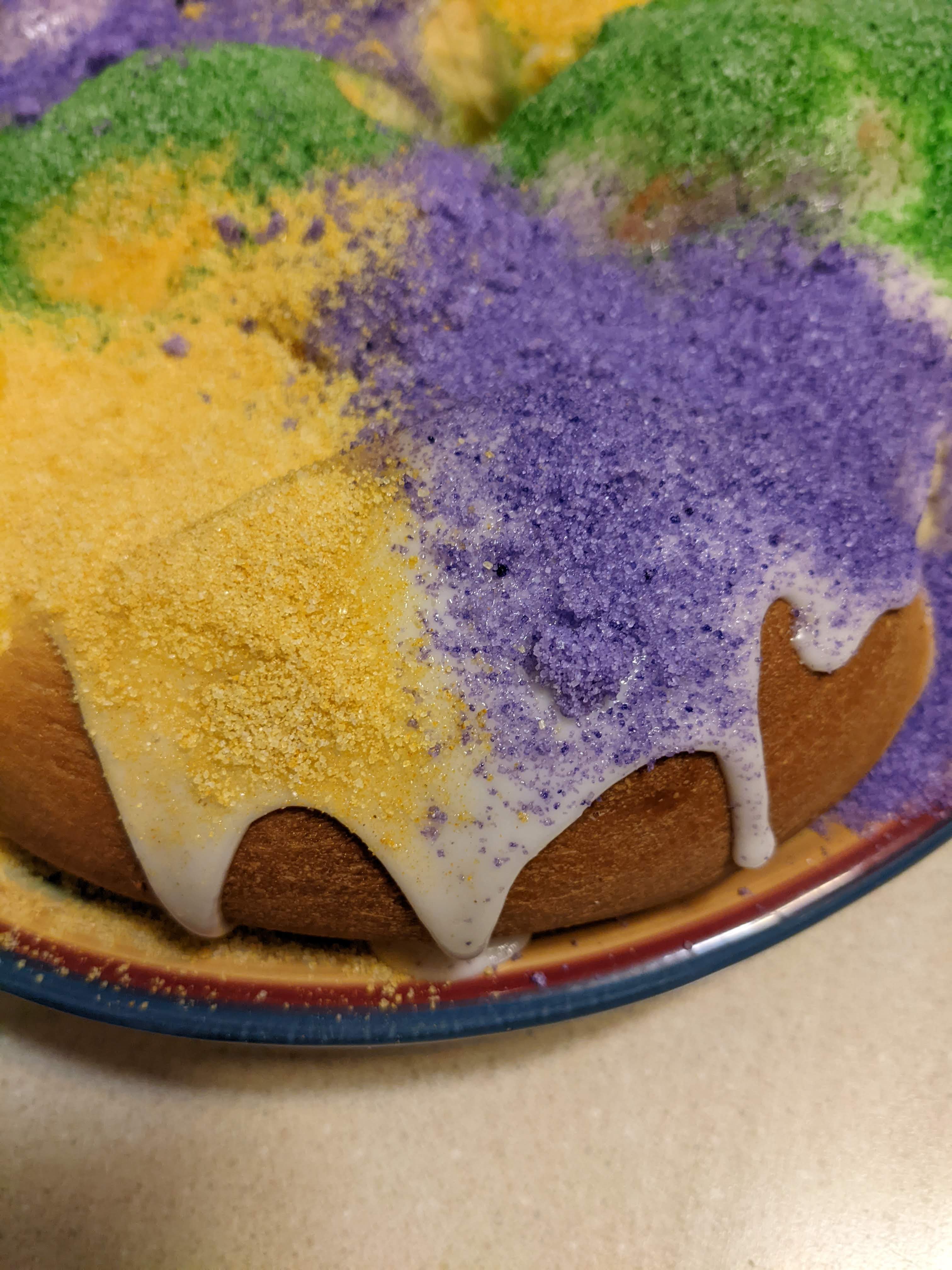
It’s one week until Mardi Gras, and you still haven’t made a king cake? Let’s fix that.
Recently, I was reminded that Carnival, or the season following Christmas and preceding Lent, is a heckin’ long season full of celebrations and indulgence celebrated in many parts of the country (but especially New Orleans) and world and, alas, not so much here where I live.
Recently, I learned that people in New Orleans don’t just eat king cake on Mardi Gras. They eat it all. Carnival. Season. Long. Along with all of the other “Mardi Gras”-adjacent foods. Whoa.
Upon learning this last month, I’ve been happily plugging away at all sorts of Carnival recipes, including experimenting with Shrove Tuesday buns from the last post, perfecting my muffuletta loaves (which I may divulge in a later post, when I get the recipe where I want it), and playing around with king cake more than one day a year. Nothing is sadder than having almost an entire king cake turning stale and mocking you from the kitchen counter while you fast on Ash Wednesday. Nothing.
This is the king cake recipe I’ve been using for the past couple of years – it’s based on a Mark Bittman recipe (thank you, sir), and I’m in love with it because it boasts a lightly-sweet, spiced yeast cake that takes well to oodles of glaze and crunchy colored sugar. I’ll say it as I always do – freshly ground spices are your friends here.
The cake is *gasp* unfilled, which I was skeptical of at first (aren’t all king cakes filled with something?!), but its simplicity is what makes it stand out. Plus, I got high praise from a native New Orleansian (or however you say it), so I’m sticking to my recipe.
However, if you must have filling, feel free to fill the braids with your filling of choice. (Full disclosure, I’ll likely experiment with a filling this year that includes some stale gingerbread cookies. Yes, from Christmas. Yes, they’re still fine. Don’t judge me.)
As far as colors, I’ve done this cake with regular ol’ food coloring gel for the sugar, as well as some natural plant alternatives (namely, turmeric and saffron for the gold, and a cranberry sugar for the “purple.” I’m trying matcha for the green this year). Variations are in the recipe below, and you can see the differences in color in the pictures below:
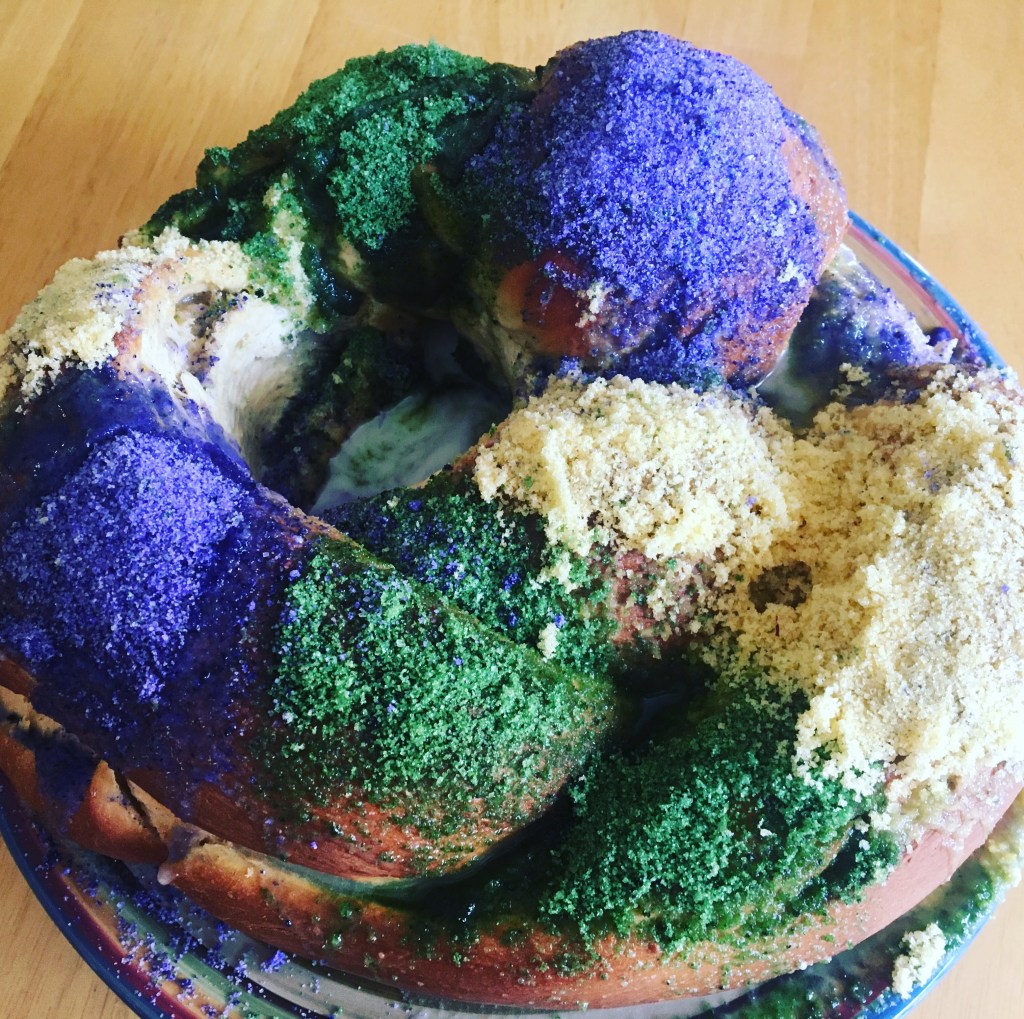


The last one has the most replacements for coloring. All things considered, the amount of food coloring used in the sugars (a few drops at most, if you’re using food gel instead of liquid coloring, which you should) won’t kill you. *ducks*
Aaaaaanyway, I suggest doing the fun king cake thing and adding a trinket to the cake so someone can be queen/king for the day (and owe you a king cake next week, or month, or year). I prefer edible “trinkets,” such as nuts or chocolate chips, since I don’t like the idea of biting down on a piece of plastic or ceramic by mistake, but you’re the boss of your own cake and can do what you want.
With all of that said, laissez les bon temps rouler! Let’s make some king cake.
Mardi Gras King Cake
Legend has it that whoever finds the trinket - be it a plastic or ceramic baby, nut, or other small object - has to buy the next year’s cake with their newfound royal status. For best results, use freshly-ground spices.
you will need:
- 2 tablespoons yeast
- ½ c warm water (110-115 degrees F)
- ½ c granulated sugar
- 1 tsp cinnamon
- ½ tsp nutmeg
- zest of one medium lemon (about 2 tsp)
- 1 tsp kosher salt
- ½ c butter, melted and cooled slightly (1 stick)
- 5 egg yolks
- ½ c warm milk
- 4-4 ½ c all-purpose flour
- 1 heatproof empty can (such as a soup can with its label removed)
- 1 whole almond, or trinket of choice For the glaze and sugar decoration:
- 3 c powdered sugar, sifted
- ¼-½ c milk or water
- 2 tsp vanilla extract
- granulated sugar (about 1 c, divided)
- gel food coloring (green, gold, and purple)
Directions
- In a large bowl or bowl of a stand mixer, dissolve the yeast in the warm water and with 1 tsp of the sugar, and allow to bloom for 5 minutes. Whisk in the sugar, spices, lemon zest, salt, butter, egg yolks, and milk until combined. With a wooden spoon, add in about 2 c of the flour until well incorporated, then add flour, ½-1 c at a time, until the dough begins pulling away from the sides of the bowl.
- If using a stand mixer, use the dough hook attachment to knead the dough until smooth and satiny, adding flour a tablespoon at a time only if the dough is very sticky, about 6-8 minutes. Alternatively, turn the dough out onto a lightly floured surface, and knead until smooth.
- Grease a large bowl with butter or neutral oil, turn dough into bowl and coat all sides with oil, cover with a tea towel, and allow to rise in a warm place until doubled, about 1-1 ½ hours.
- Preheat the oven to 375°F, line a baking sheet with parchment paper or a Silpat, and place the heatproof can in the middle of the sheet. Put a little water into a small bowl. Punch down dough, turn dough out onto a lightly floured surface, and divide into 3 equal pieces. Roll each piece into a rope about 18 inches long (the dough may shrink back a bit – this is normal), and stick the tops of the dough pieces together using a little water from the bowl. Braid the ropes together (like you would hair), then wrap the braid around the can on the baking sheet, sealing the ends together by pinching them with a little bit of the water. Cover, and allow to rise again until doubled in size, about 30-45 minutes.
- Bake the cake until golden, about 20-30 minutes, rotating the pan halfway through baking. Allow to cool completely before glazing decorating.
- Make the glaze: Sift the powdered sugar into a medium bowl, and whisk in vanilla. Whisk in ¼ c milk or water, then add more liquid, 1 tablespoon at a time, until you get a pourable glaze of your preferred consistency.
- Prepare the sugars: Divide sugar into three small bowls. Add 1-2 drops gel food coloring to each bowl (different colors for each bowl – green, gold, and purple), and mix to combine (you can do this with a spoon, but it’s easier to fully incorporate colors with gloved hands). Allow to dry completely before using, about 1 hour. Alternatively, if you’re looking to avoid food coloring, I’ve found that ¼ tsp turmeric or a pinch of saffron mixed with a few drops of water makes an excellent gold (with a little extra flavor added), while a bit of reduced blueberry juice can work for purple, and matcha powder for green. These alternative food colorings will affect the taste of the sugar slightly, but not in an unpleasant or significant way.
- If using a trinket, push the nut or other object halfway into the cake from the bottom, and place cake onto a serving platter. Pour glaze over the cake, and dust the cake generously with the colored sugar.
 The Crunchy Baker