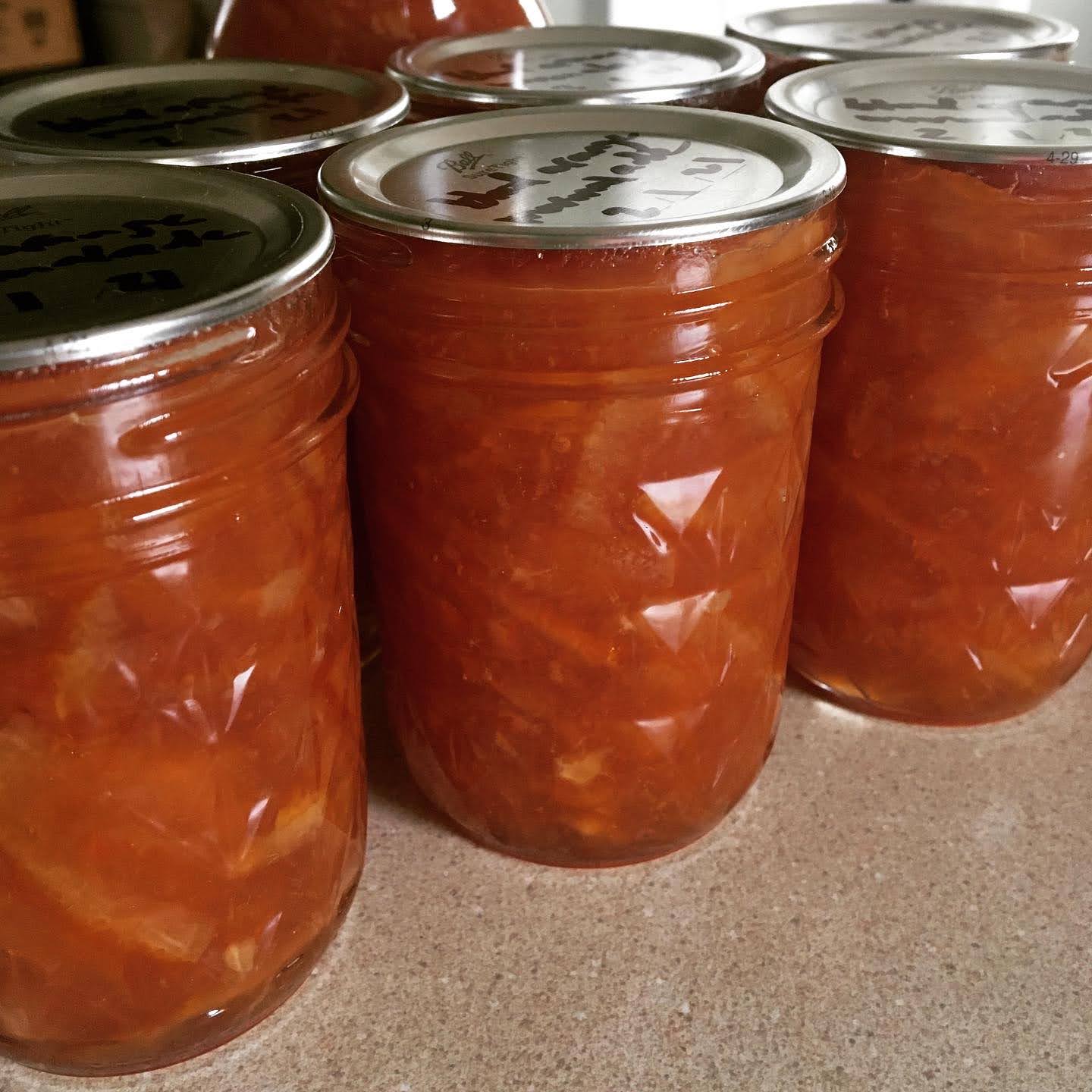
The sun is shining, the birds are singing…
Wait, wait. Wrong season. Let’s try that again.
The sun is shining (hey, we’re in the South), the crows are cawing, the air is icy, and it’s blood orange season. Huzzah!
Alas, we cannot grow our own blood oranges where we live, but they do start appearing in grocery stores around this time of year because, in case you didn’t know (and I sure didn’t until I worked at a grocery store oh so long ago), citrus fruits have seasons, too. Blood oranges in particular grow and ripen in cooler months (like January) because they need cooler nights to get that characteristic red color.
I love marmalade (as I waxed in my original Marmalade post), and I particularly love blood orange marmalade. Blood oranges tend to be a touch sweeter than most other eating oranges, and the color is just gorgeous, both for slicing and for making marmalade. Unlike regular orange marmalade, which retains a yellow-orange hue, blood orange marmalade is a ruby confection, great for topping toast, desserts, and danishes.
Making marmalade is pretty simple, and is an excellent winter activity. Fair warning, though – it does require extra boiling and, because we rely on the natural pectin in the oranges rather than commercial pectin, it takes longer to set than a jam made with powdered or gel pectin. But that’s what January is for, isn’t it? Slowing down, sitting near a warm stove, and reading a book while occasionally stirring a bubbling marmalade. Aaaaaah.
Oh, and P.S. – you can use regular oranges for making this marmalade, but if you can find blood oranges, get them. It’s well worth it. Let’s make marmalade!
Blood Orange Marmalade
This makes a lovely ruby-colored marmalade with a sweeter flavor than traditional Seville orange marmalade. The first part of the recipe requires an overnight soak, so plan accordingly. Adapted from the New Ball Book of Canning and Preserving.
you will need:
- 4 ½-5 lbs blood oranges, washed, scrubbed, and divided (about 12-15 oranges, depending on size)
- 8 c granulated sugar
- ¼ c fresh or bottled lemon juice
Directions
1. Cut half of the oranges into quarters lengthwise, then thinly slice oranges crosswise. (When you do this correctly, the pithy center will be on the bottom of the cutting board – your slices should not have a pithy streak down the middle. If they do, flip the orange to the other end and slice.) Place orange slices in a large saucepan, and add enough water to cover. Bring to a boil, then remove from heat, cover, and allow to stand at room temperature for at least 8 hours or overnight.
2. The next day, squeeze juice from the remaining oranges into a large glass measuring cup and set aside. Compost rinds or reserve for another use. (You can boil orange peels with other spices to make your house smell delightful, or use them to garnish your drink, or whatever.)
3. Transfer the soaked blood orange slices from Step 1 to a 6-quart stainless steel saucepan or Dutch oven; reserve the soaking liquid. Add enough soaking liquid to the blood orange juice from Step 2 to equal 4 cups. Discard remaining soaking liquid, or find another use.
4. Add blood orange juice mixture, sugar, and lemon juice to orange slices. Bring to a rolling boil over high heat. Reduce heat to medium and simmer, stirring frequently to prevent scorching, until the mixture reaches gelling point (220 degrees with a candy thermometer).
5. If canning, prepare canner and jars. Ladle hot marmalade into half-pint jars, leaving ¼ inch headspace. Remove air bubbles. Wipe rim with clean, wet towel, center lids on jars, and screw bands to fingertip tight. Process in boiling water canner for 10 minutes. Turn off heat, remove lid, and allow to stand for 5 minutes. Remove jars from canner and cool completely. Store.
 The Crunchy Baker
[…] Blood Orange Marmalade […]
LikeLike